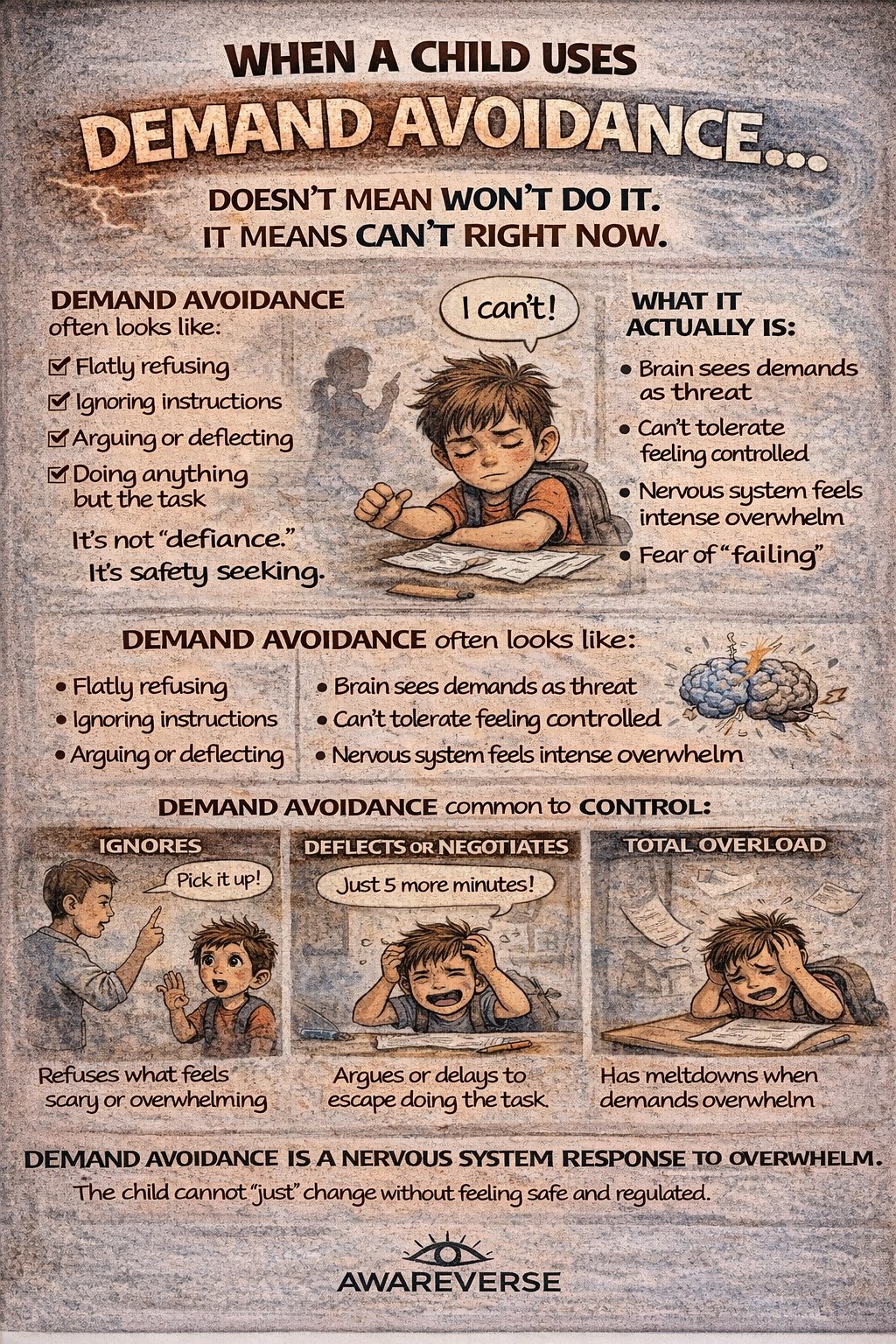
Won’t do it often means can’t right now. The nervous system can experience a demand as threat, not the child choosing to be difficult.
Demand avoidance describes a pattern where a child’s nervous system registers demands like instructions, requests, and expectations as threat. When the brain detects threat, it tries to escape. Avoidance is a protective response.
This is not wilful non compliance. It is often automatic. The child may want to do the task, but cannot access the ability in that moment.
Demand avoidance is often associated with autism, ADHD, and anxiety, and is also recognised within a profile sometimes called PDA. Demand avoidance as a response can also show up in any child under enough stress.
Standard behaviour strategies like sanctions, pressure, and repeated instructions often make it worse, because they increase threat and demand load.
The key distinction is this: it is not won’t, it is can’t. Pushing harder does not create compliance. It creates crisis.
Demand avoidance is a common reason standard school behaviour systems fail neurodivergent children. Systems built on instruction, sanction, and reward can be incompatible with a nervous system that experiences demands as threat.
If avoidance increases when consequences are applied, the approach is making it worse. The solution is not more pressure. It is less demand, more safety, and a relational approach.
Demand avoidance is a nervous system response to overwhelm. A child cannot change without first feeling safe.
If this helped you, please share it with another parent, teacher, or professional who needs it.
Download PNG Back to Library