AwareSTEM · Space Atlas

Explore the Solar System

A visual learning hub for the Sun, planets, moons and dwarf planets. Built for learners who like strong images, clear facts, practical activities and real science without gatekeeping.

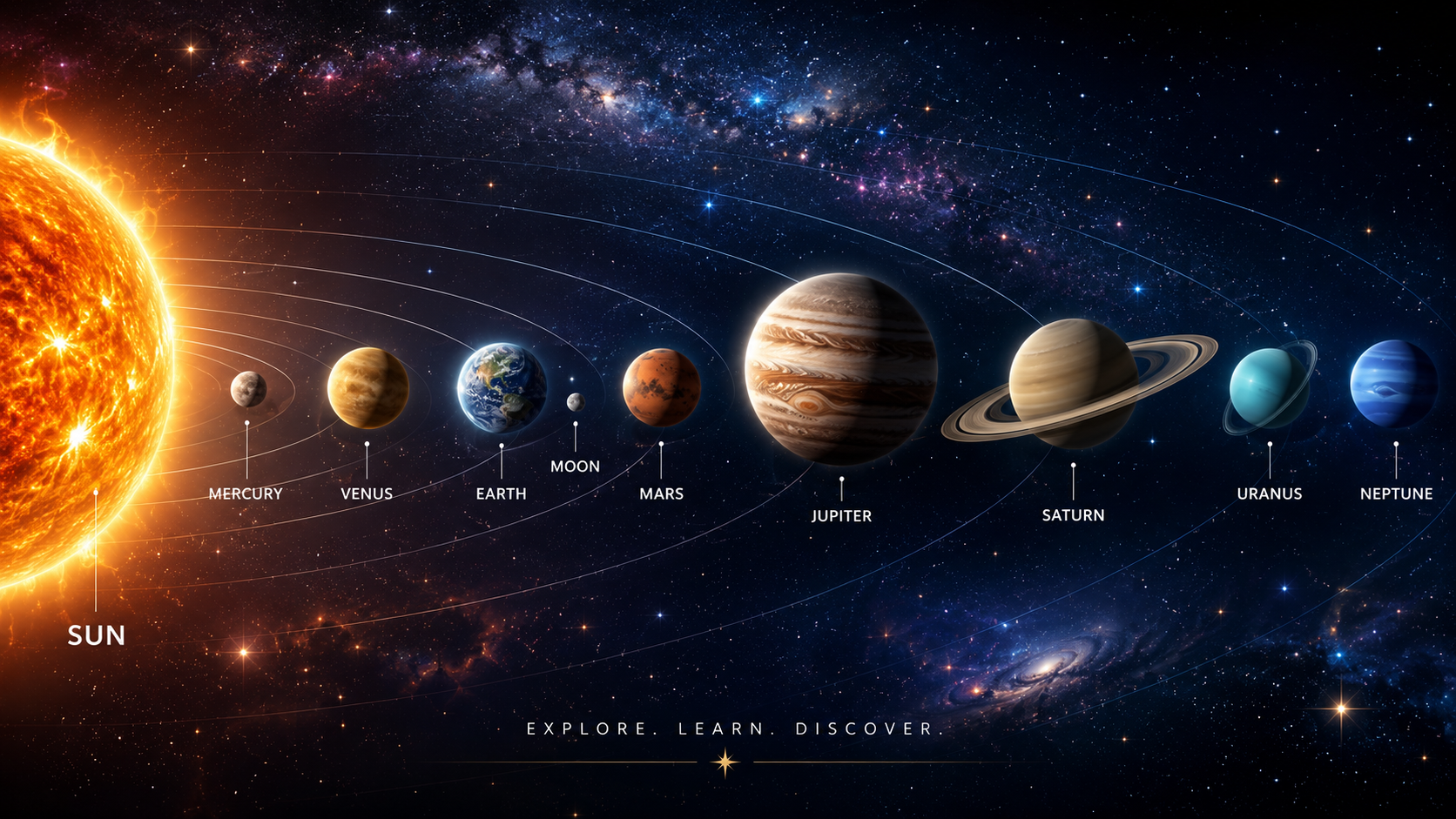
Start with the overview image, then open each world to learn what it is, why it matters, and what makes it strange, beautiful or scientifically important.

Solar System overview showing the Sun, planets and orbital paths
Solar System Overview
20visual atlas maps
8main planets
5dwarf planets
6major moons

How to use this atlas

This page is designed to be visual first. Look at the image before reading the text. Notice colour, texture, rings, craters, storms, ice, clouds and surface patterns.

1LookStudy the image and say what you notice first.
2AskWhat changed this world: heat, gravity, impacts, ice, atmosphere or time?
3ComparePick two worlds and explain why they look different.
4BuildDesign a mission, model, poster or experiment.

Why it fits AwareSTEM

Space is perfect for neurodivergent friendly STEM because it is visual, pattern based, curiosity driven and full of real questions. This atlas can support astronomy, physics, chemistry, geology, robotics, coding, mission design and home education.

This is not just a gallery. It is the start of a proper AwareSTEM space pathway.

New — Interactive

🌌 Solar System Explorer

A fullscreen interactive map of the Solar System. Drag to pan, scroll to zoom, click any world for facts and mission links. Includes animated orbits, planet details and Mission Builder links.

Open Explorer →
Choose a section
Start Here

Begin with the Sun, the object that holds the Solar System together.

Rocky Worlds

Small solid worlds with surfaces you can map, compare and investigate.

Giant Planets

Huge outer planets with storms, rings, clouds and powerful gravity.

Moons

Natural satellites with volcanoes, oceans, atmospheres and ancient surfaces.

Dwarf Planets

Small worlds that show how strange and varied the outer Solar System is.

Learning panels
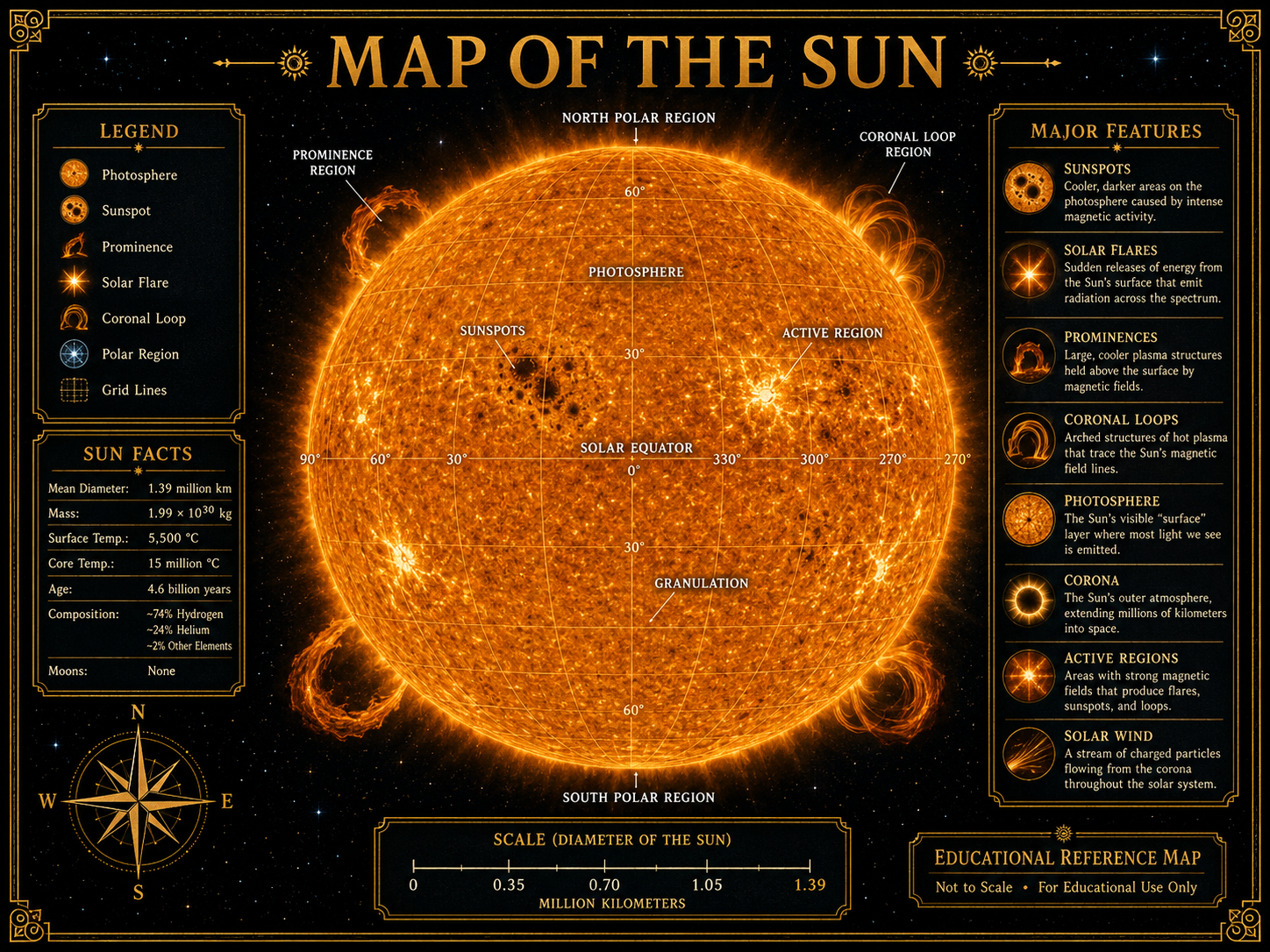
The Sun detailed map
Star

The Sun

The star at the centre of the Solar System

The Sun is a huge ball of hot plasma. Its gravity holds the Solar System together, and its energy gives Earth light, heat, weather and life.

Why this world matters

The Sun is the engine of the Solar System. It controls orbits, warms planets, drives space weather and sends out charged particles known as the solar wind.

Interesting facts

  • Light from the Sun takes about 8 minutes to reach Earth.
  • Sunspots are cooler, darker magnetic regions on the Sun’s visible surface.
  • Solar flares can release huge bursts of energy into space.
  • The Sun is mostly hydrogen and helium.

Try this

Make a Sun safety poster explaining why we never look directly at the Sun through eyes, binoculars or a telescope.

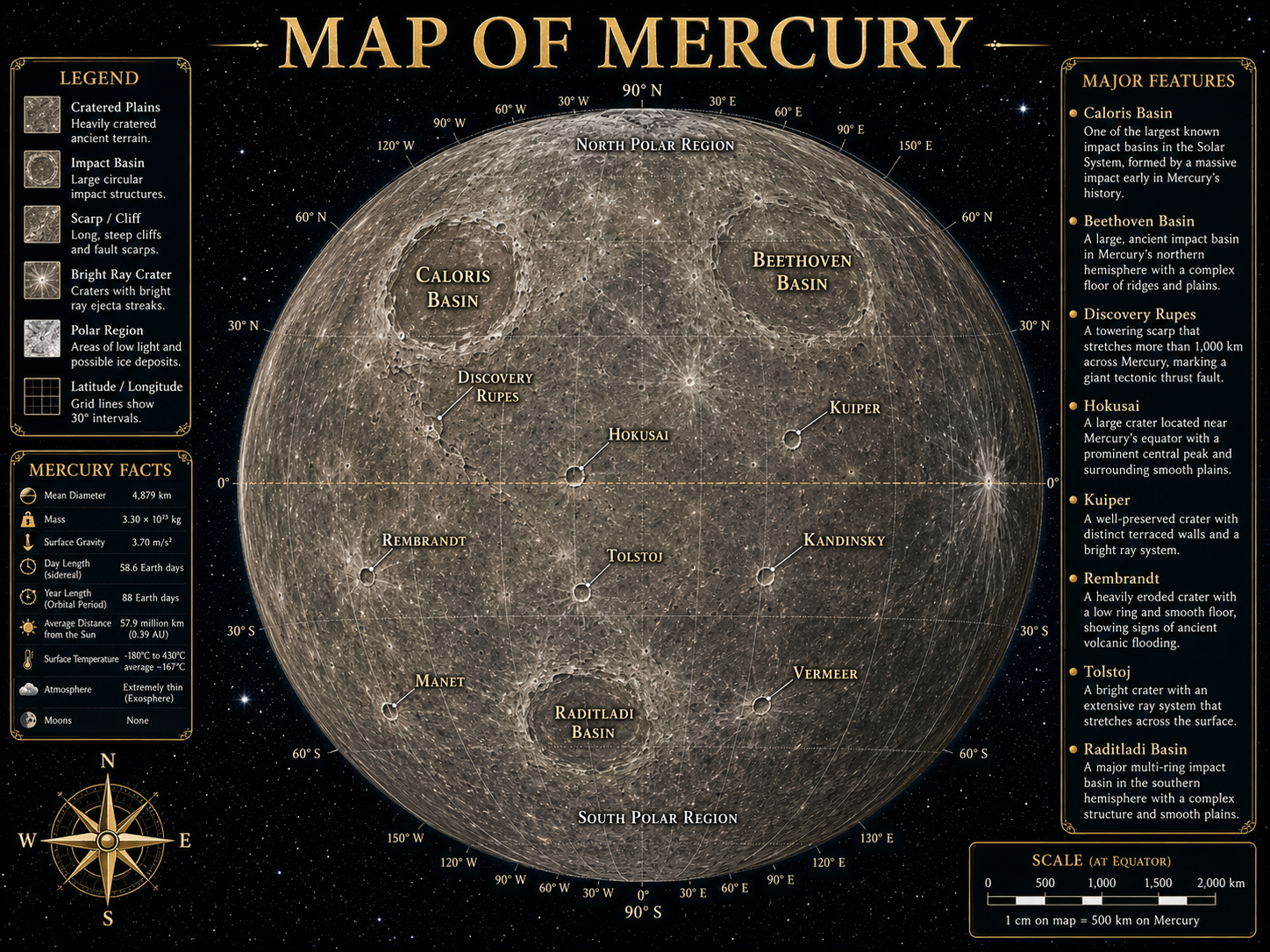
Mercury detailed map
Rocky Planet

Mercury

The closest planet to the Sun

Mercury is the smallest main planet. It is rocky, heavily cratered and has almost no atmosphere.

Why this world matters

Mercury helps us understand what a small rocky world looks like when it has little protection from space impacts and solar radiation.

Interesting facts

  • A year on Mercury lasts only 88 Earth days.
  • Mercury has extreme day and night temperature changes.
  • Its surface looks similar to the Moon because it is covered in impact craters.
  • There is ice hidden in permanently shadowed craters near its poles.

Try this

Compare Mercury with the Moon. List three similarities and one difference.

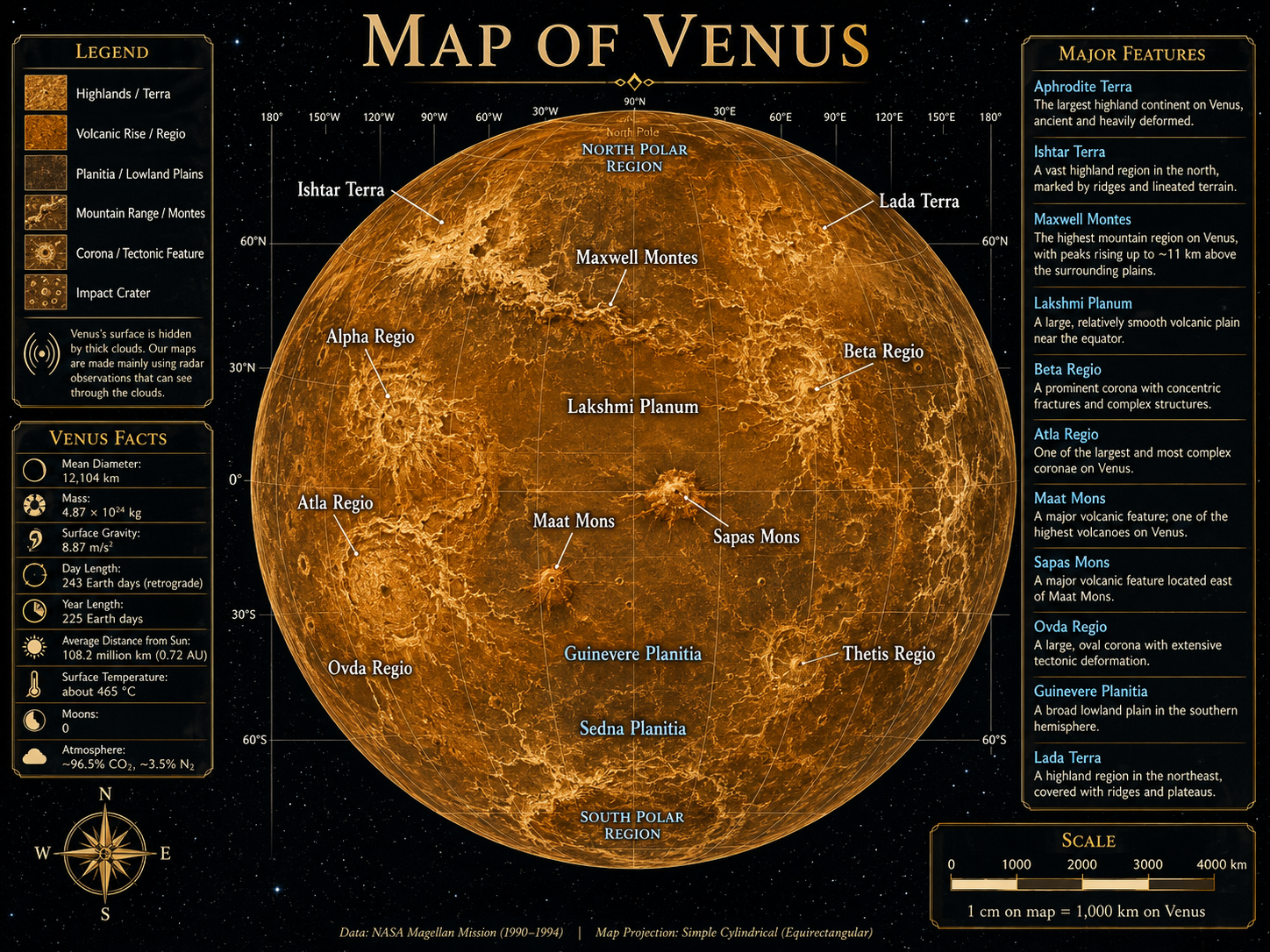
Venus detailed map
Rocky Planet

Venus

A hot world hidden under thick clouds

Venus is similar in size to Earth, but its thick carbon dioxide atmosphere traps heat and creates crushing pressure.

Why this world matters

Venus is one of the best examples for learning about atmospheres, greenhouse heating and how planets can develop very differently.

Interesting facts

  • Venus is hotter than Mercury even though Mercury is closer to the Sun.
  • Its clouds contain sulfuric acid.
  • Venus rotates backwards compared with most planets.
  • Radar is used to map its surface because clouds hide the ground.

Try this

Make a comparison table showing Earth versus Venus: atmosphere, temperature, water, pressure and habitability.

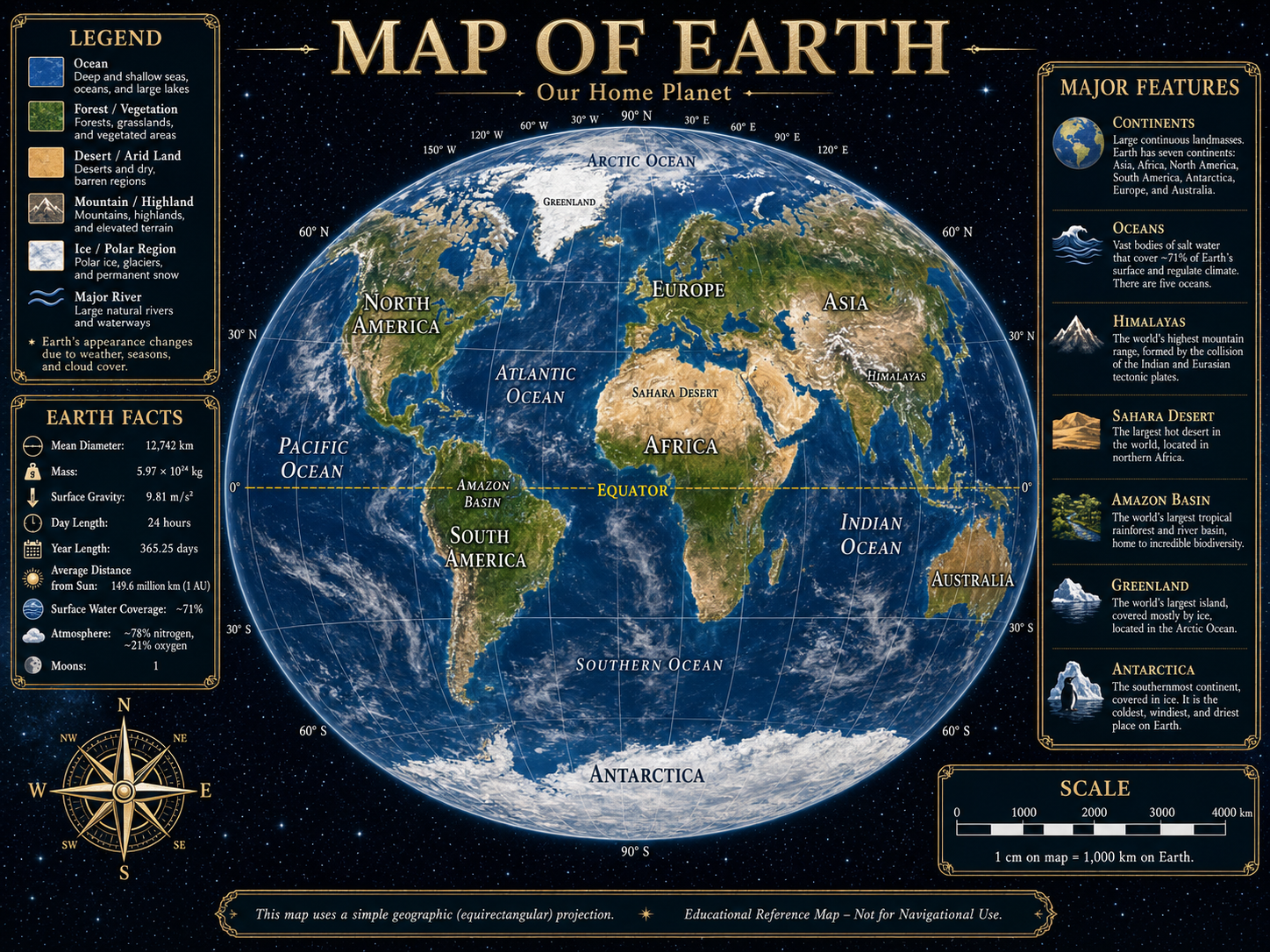
Earth detailed map
Rocky Planet

Earth

Our home planet

Earth has liquid oceans, active geology, weather, a protective atmosphere and the only confirmed life in the Universe.

Why this world matters

Earth is our reference point. When we study other worlds, we compare them with Earth to understand life, climate, water and change.

Interesting facts

  • About 71 percent of Earth’s surface is covered by water.
  • Earth’s magnetic field helps protect it from charged particles from the Sun.
  • Plate tectonics constantly reshapes the surface.
  • The Moon helps stabilise Earth’s tilt.

Try this

Choose one Earth system, such as oceans, clouds, volcanoes or ice, and explain how it changes the planet.

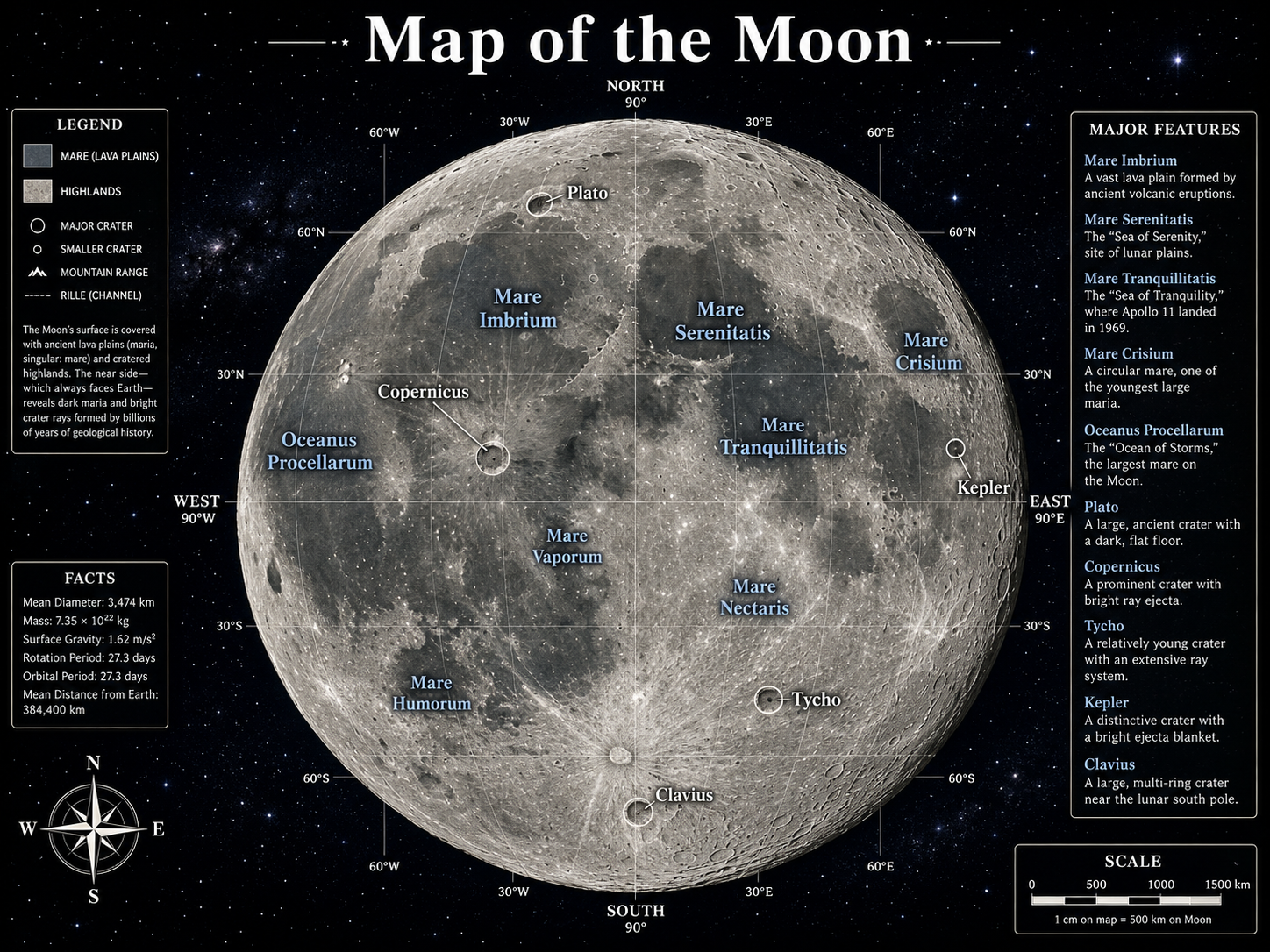
The Moon detailed map
Moon

The Moon

Earth’s natural satellite

The Moon has dark lava plains, bright highlands, impact craters and no thick atmosphere.

Why this world matters

The Moon is close enough to observe from Earth and preserves a long record of impacts and ancient volcanic activity.

Interesting facts

  • The dark patches are called maria, meaning seas, but they are ancient lava plains.
  • The Moon is slowly moving away from Earth.
  • Only one side usually faces Earth because the Moon is tidally locked.
  • Moon craters last a very long time because there is no rain or wind like Earth.

Try this

Find one mare, one crater and one highland region on the Moon map.

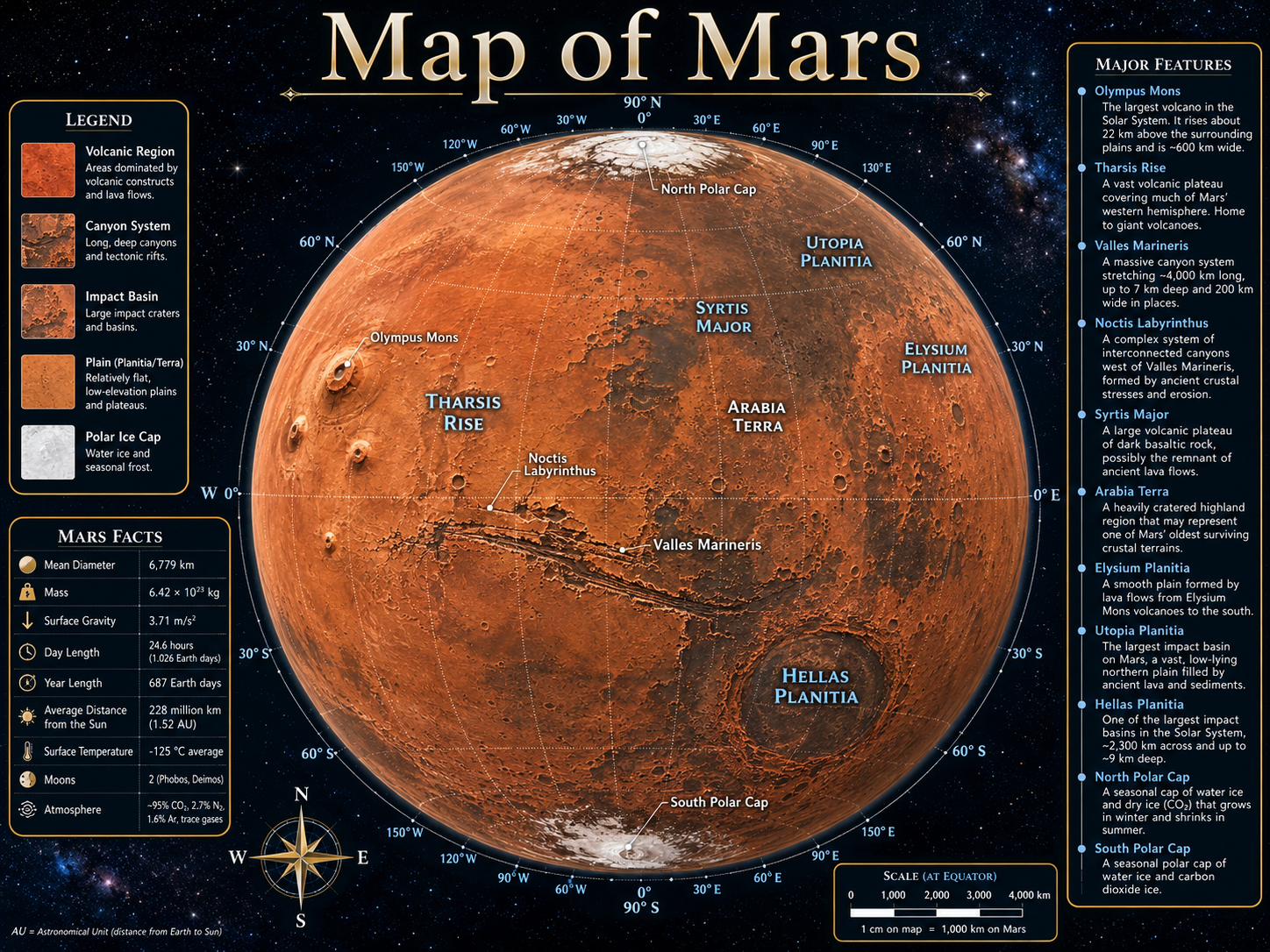
Mars detailed map
Rocky Planet

Mars

The red planet

Mars has giant volcanoes, deep canyons, dust storms and evidence that liquid water once flowed across its surface.

Why this world matters

Mars is one of the best places to study whether life could once have existed beyond Earth.

Interesting facts

  • Olympus Mons is the tallest volcano known in the Solar System.
  • Valles Marineris is much larger than the Grand Canyon.
  • Mars has seasons because its axis is tilted.
  • Its red colour mostly comes from iron oxide, similar to rust.

Try this

Design a Mars rover. Decide whether it should search for water, rocks, fossils, weather data or safe landing places.

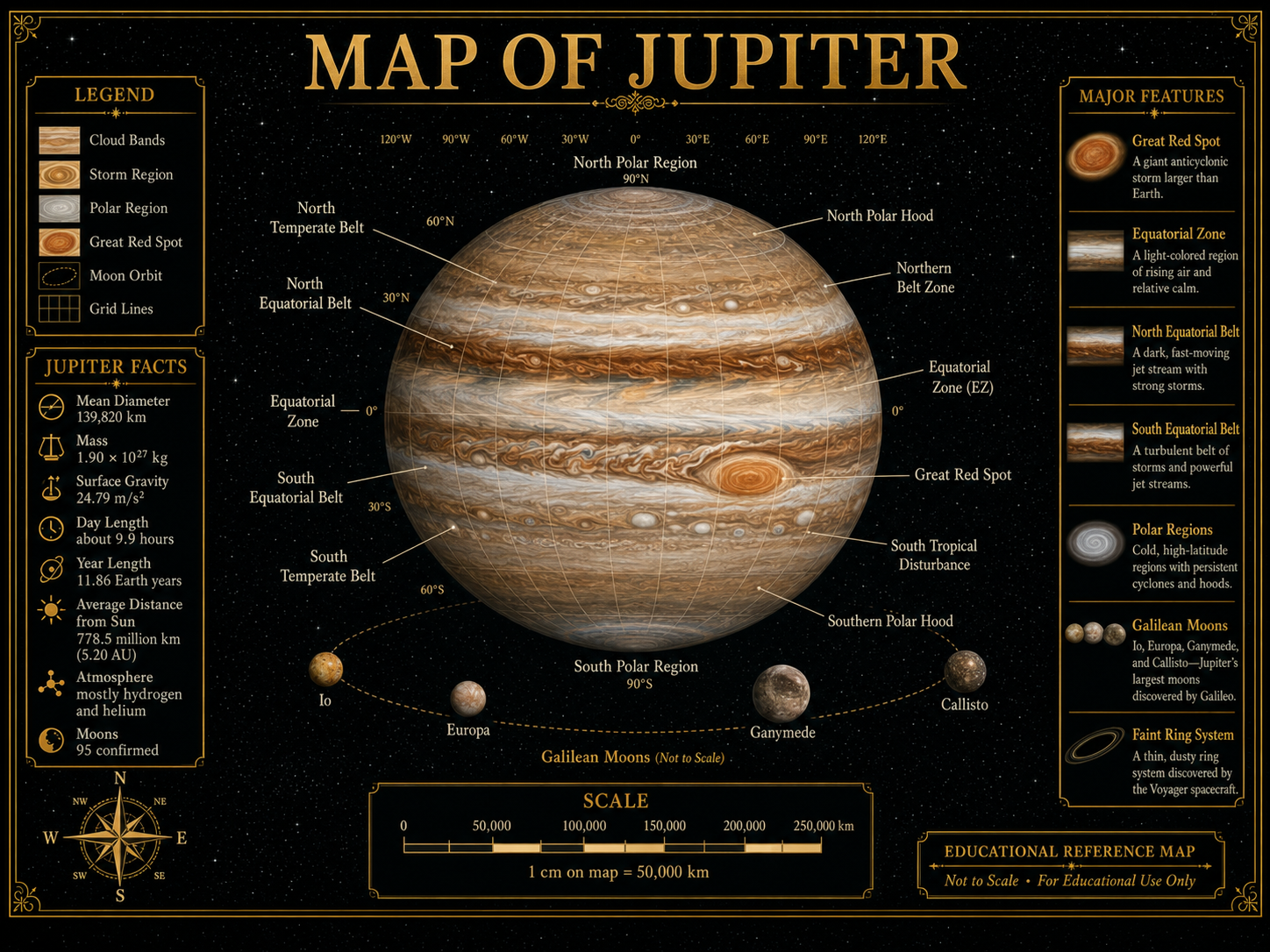
Jupiter detailed map
Gas Giant

Jupiter

The largest planet

Jupiter is the largest planet, with colourful cloud bands, powerful storms and a huge family of moons.

Why this world matters

Jupiter’s gravity shaped much of the Solar System, and its moons are worlds worth studying in their own right.

Interesting facts

  • The Great Red Spot is a giant storm larger than Earth.
  • Jupiter has no solid surface like Earth.
  • Its magnetic field is extremely powerful.
  • The four largest moons are Io, Europa, Ganymede and Callisto.

Try this

Pick one Jupiter moon and explain why it might be more interesting to explore than Jupiter itself.

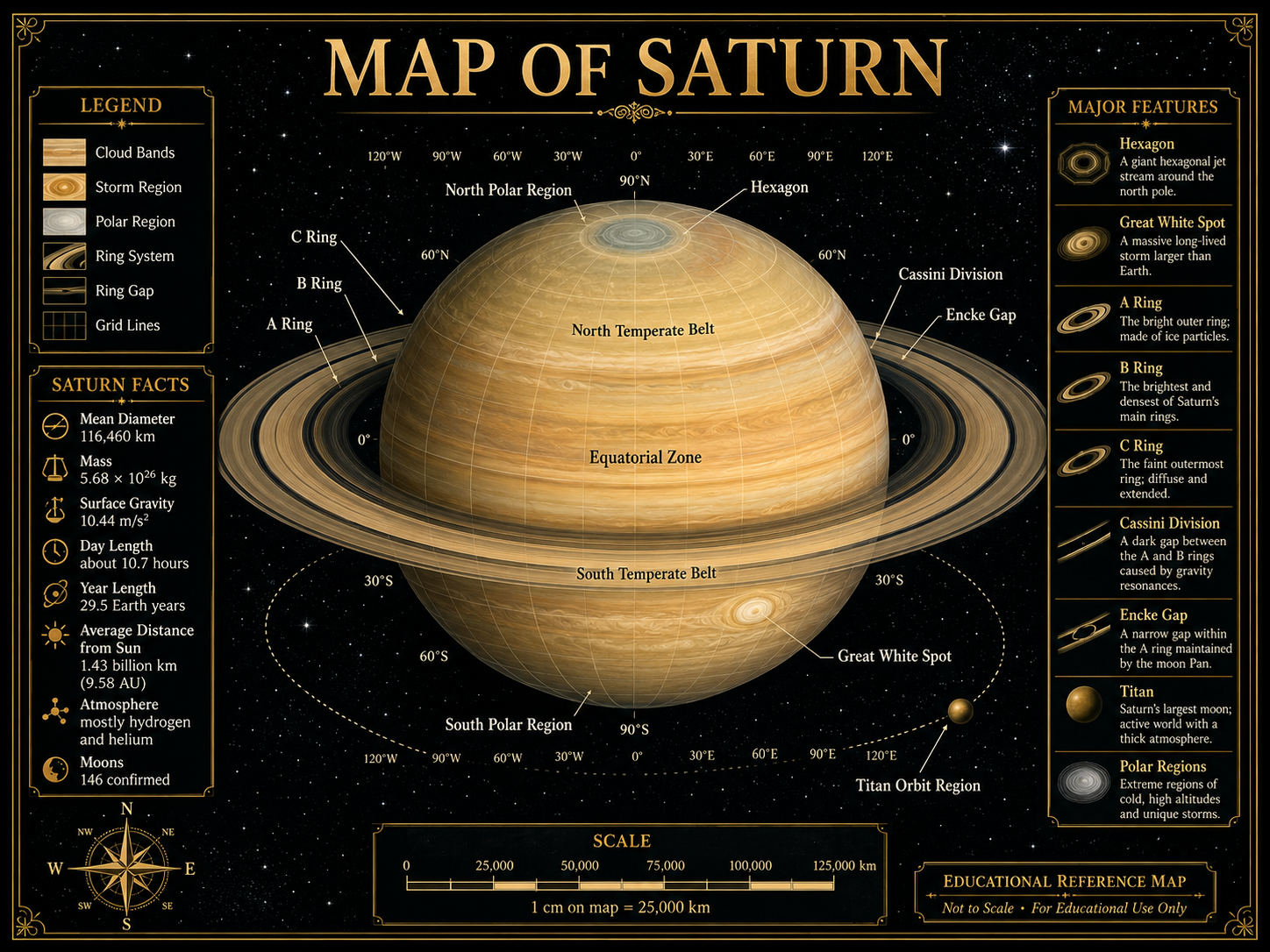
Saturn detailed map
Gas Giant

Saturn

The ringed planet

Saturn is famous for its huge ring system made mostly of ice particles, with rock and dust mixed in.

Why this world matters

Saturn shows how beautiful and complex ring systems can be. Its moon Titan is also one of the most fascinating worlds we know.

Interesting facts

  • Saturn’s rings are wide but very thin compared with the planet.
  • Saturn is less dense than water overall.
  • It has strong winds and cloud bands.
  • Titan has a thick atmosphere and methane lakes.

Try this

Draw Saturn’s rings and label the planet, ring system and one moon.

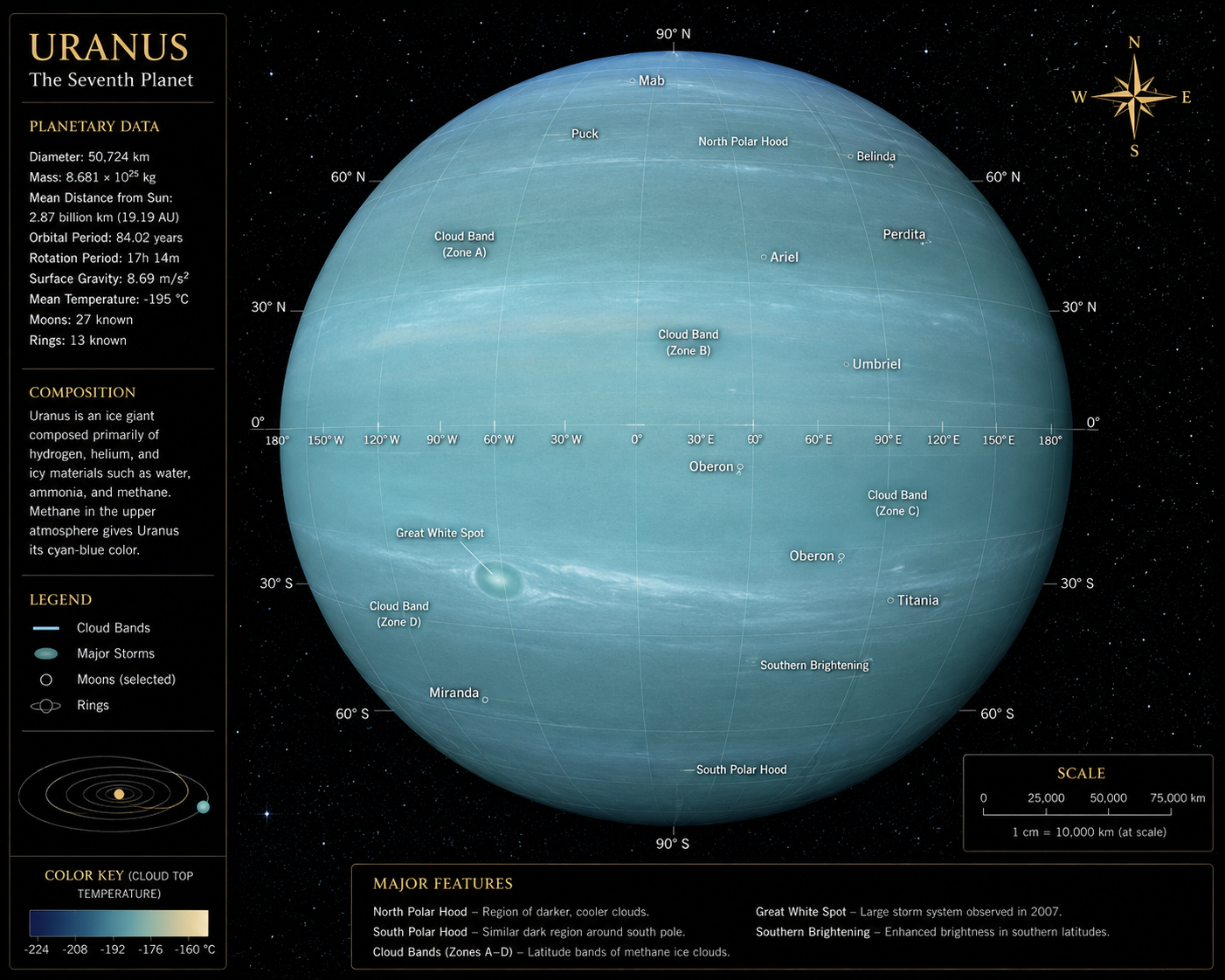
Uranus detailed map
Ice Giant

Uranus

The tilted ice giant

Uranus is a blue green ice giant with an extreme sideways tilt.

Why this world matters

Uranus is useful for learning about rotation, planetary tilt, seasons and how planets can behave in unexpected ways.

Interesting facts

  • Uranus spins almost on its side.
  • Its colour comes mainly from methane in the atmosphere.
  • It has faint rings.
  • A season on Uranus lasts for many Earth years.

Try this

Use a ball to model Uranus spinning sideways, then compare it with Earth’s tilt.

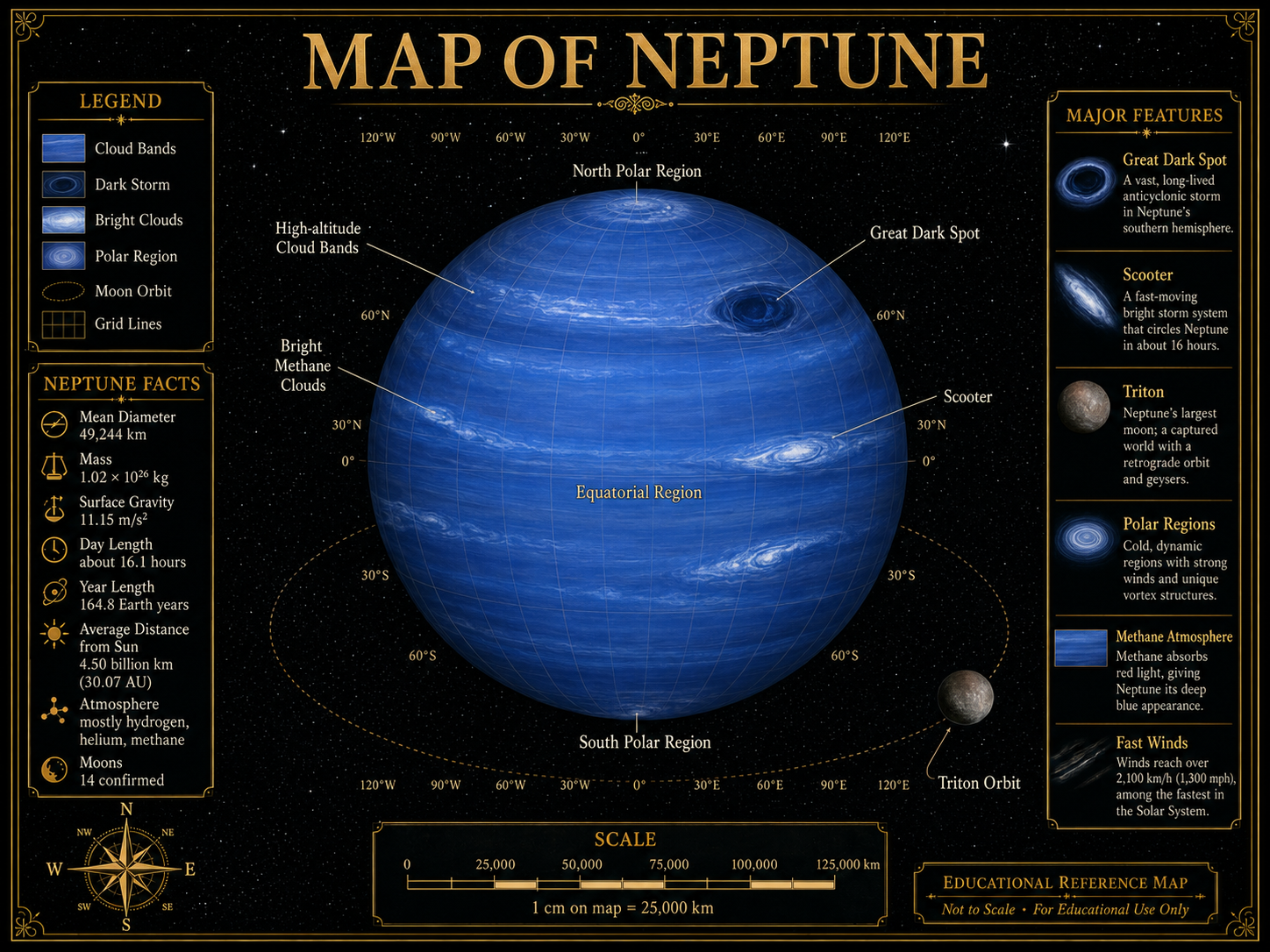
Neptune detailed map
Ice Giant

Neptune

The distant blue ice giant

Neptune is a distant ice giant with a deep blue colour, bright clouds and extremely fast winds.

Why this world matters

Neptune shows that even planets far from the Sun can still have active weather and powerful storms.

Interesting facts

  • Neptune was predicted mathematically before it was directly observed.
  • Its winds are among the fastest known in the Solar System.
  • Triton orbits Neptune in the opposite direction to Neptune’s rotation.
  • Neptune receives far less sunlight than Earth but still has active weather.

Try this

Explain why Neptune can still have storms even though it is so far from the Sun.

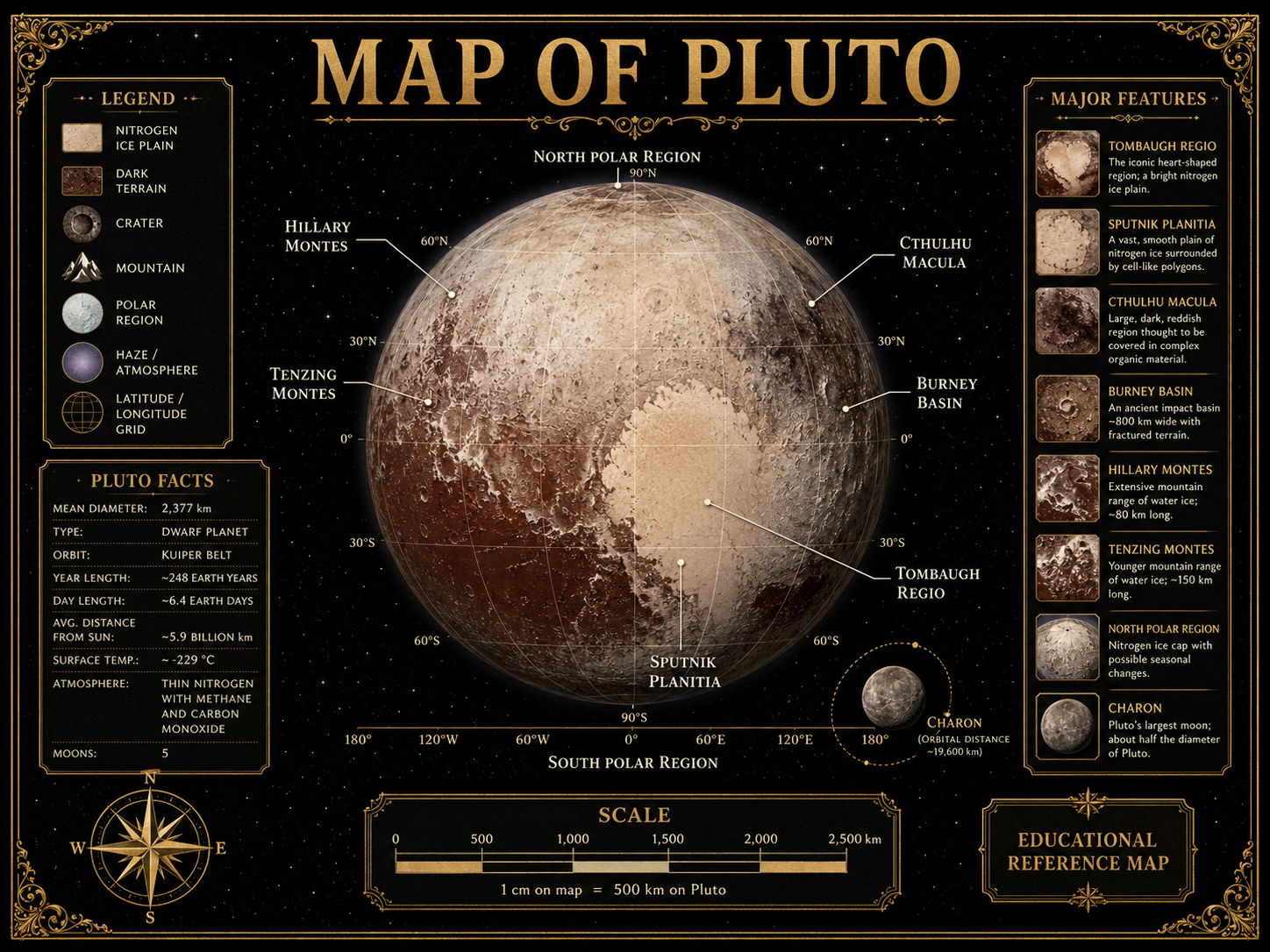
Pluto detailed map
Dwarf Planet

Pluto

A dwarf planet with a heart shaped plain

Pluto is a cold dwarf planet in the Kuiper Belt with icy mountains, a thin atmosphere and a large moon called Charon.

Why this world matters

Pluto changed how scientists classify planets and showed that small distant worlds can be geologically interesting.

Interesting facts

  • Pluto’s bright heart shaped region is called Tombaugh Regio.
  • Sputnik Planitia is a huge plain of nitrogen ice.
  • Charon is very large compared with Pluto.
  • New Horizons flew past Pluto in 2015.

Try this

Write a short argument: should Pluto be called a planet, a dwarf planet or both in everyday learning?

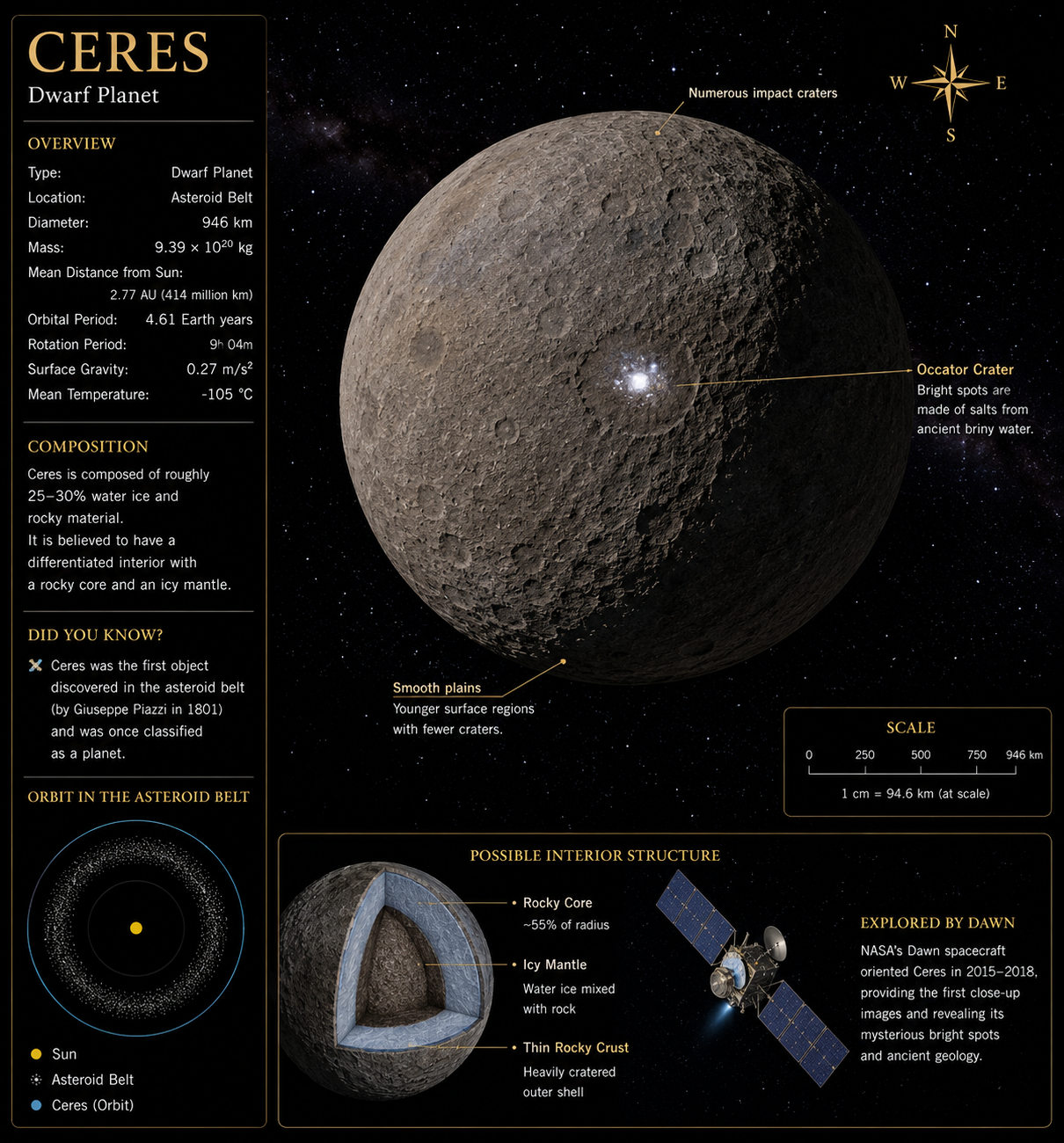
Ceres detailed map
Dwarf Planet

Ceres

The dwarf planet in the asteroid belt

Ceres is the largest object in the asteroid belt and has bright salt deposits that suggest briny liquid once reached the surface.

Why this world matters

Ceres connects rocky asteroids with icy worlds and helps scientists study water, salts and small planet formation.

Interesting facts

  • Ceres was once classified as a planet.
  • It was later classed as an asteroid, then as a dwarf planet.
  • The bright spots in Occator Crater are salt deposits.
  • NASA’s Dawn spacecraft orbited Ceres.

Try this

Create a timeline showing how Ceres was classified: planet, asteroid, dwarf planet.

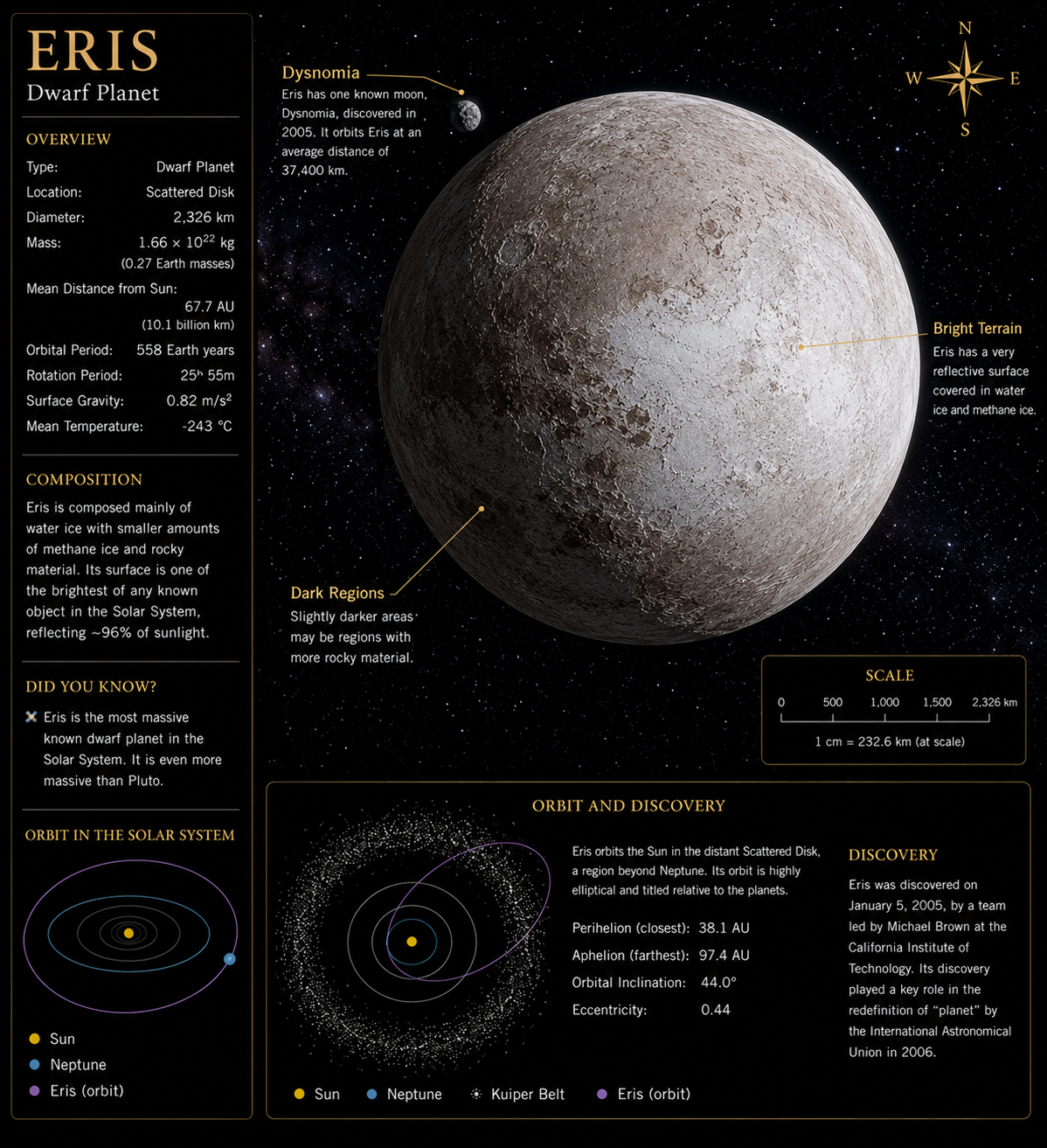
Eris detailed map
Dwarf Planet

Eris

A distant icy dwarf planet

Eris is a distant dwarf planet beyond Neptune. Its discovery helped trigger the debate that changed Pluto’s classification.

Why this world matters

Eris matters because it forced astronomers to define what a planet actually is.

Interesting facts

  • Eris is one of the most massive known dwarf planets.
  • It has a moon called Dysnomia.
  • Its icy surface reflects a lot of sunlight.
  • Its orbit is much more stretched than the main planets.

Try this

Make your own rule list for deciding whether an object should count as a planet.

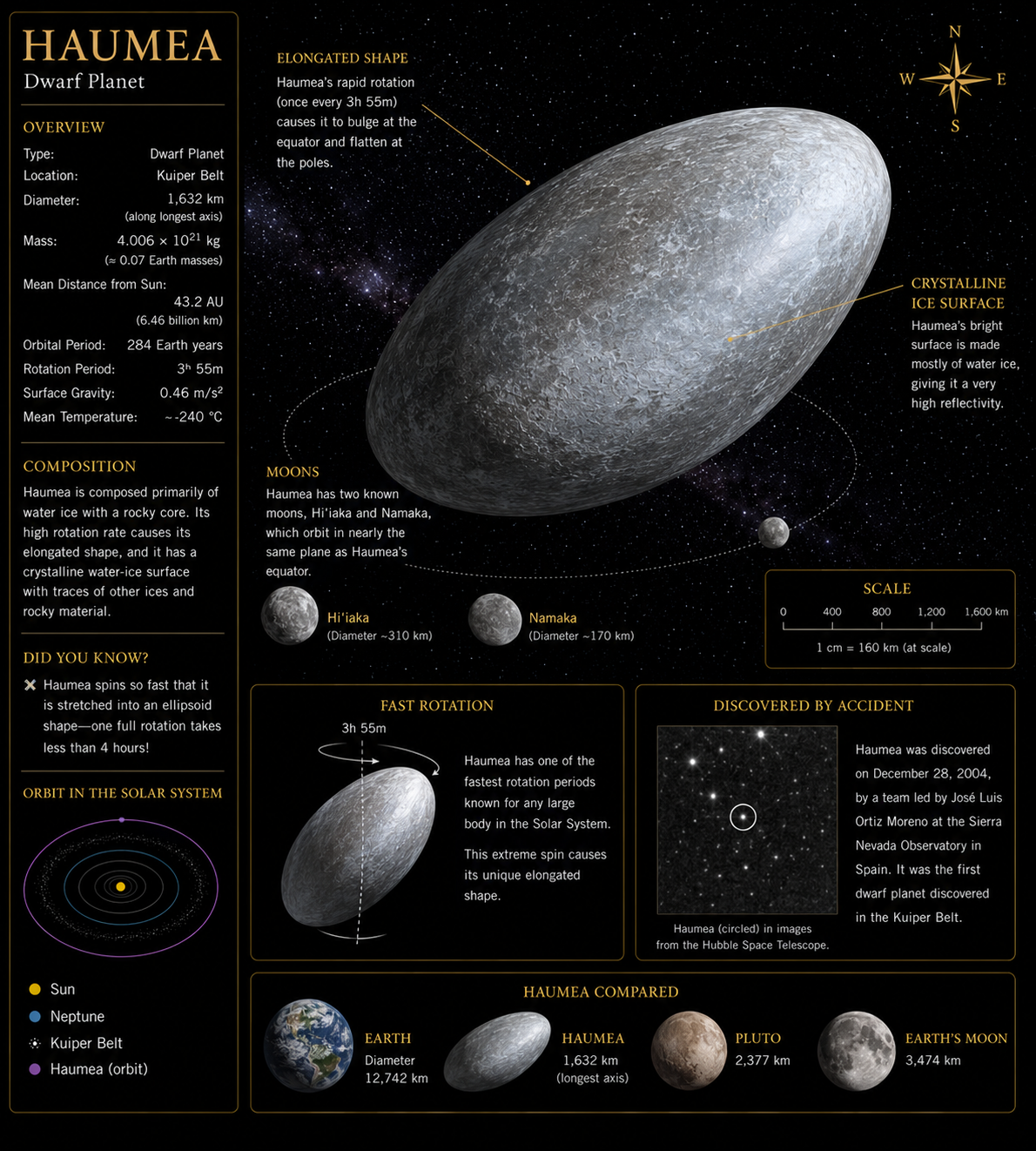
Haumea detailed map
Dwarf Planet

Haumea

A fast spinning stretched dwarf planet

Haumea spins so quickly that it is stretched into an oval shape.

Why this world matters

Haumea shows how rotation can affect the shape of a world.

Interesting facts

  • Haumea completes one rotation in only a few hours.
  • Its fast spin gives it an elongated shape.
  • It has moons.
  • It also has a ring, which is unusual for a dwarf planet.

Try this

Use clay or a soft ball to model how spinning can stretch a shape.

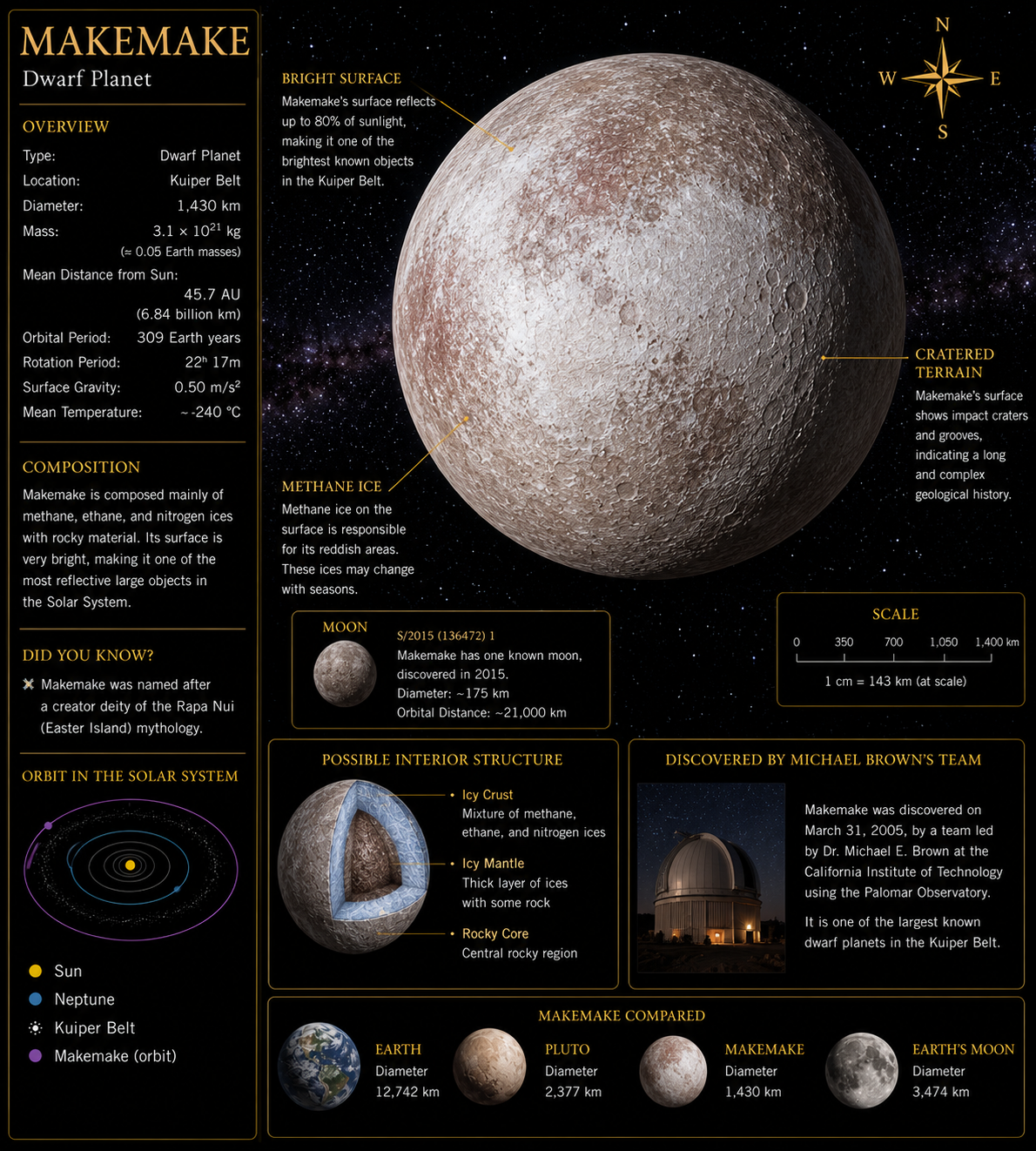
Makemake detailed map
Dwarf Planet

Makemake

A bright world in the Kuiper Belt

Makemake is a bright icy dwarf planet in the Kuiper Belt, covered with frozen methane and other ices.

Why this world matters

Makemake helps scientists understand icy outer Solar System objects beyond Neptune.

Interesting facts

  • Makemake is one of the larger known dwarf planets.
  • It is very cold and very distant.
  • Its surface is bright because of reflective ices.
  • It has a small known moon.

Try this

Compare Makemake with Pluto. What do they have in common as Kuiper Belt objects?

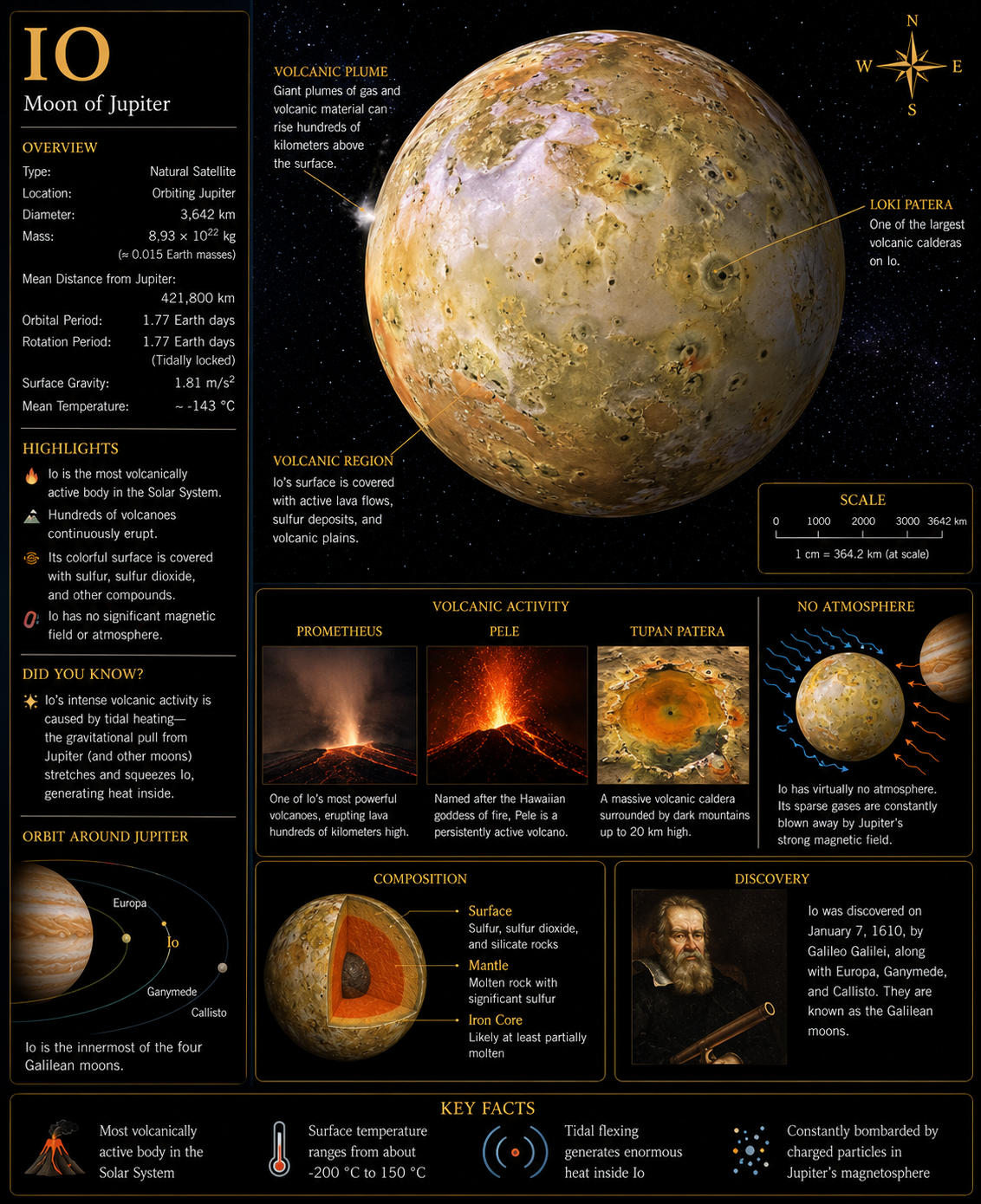
Io detailed map
Moon

Io

Jupiter’s volcanic moon

Io is the most volcanically active world in the Solar System, with lava flows, volcanic plumes and colourful sulfur deposits.

Why this world matters

Io shows how gravity can heat a moon from the inside through tidal flexing.

Interesting facts

  • Io is constantly squeezed by Jupiter’s gravity and nearby moons.
  • Its volcanoes can send plumes high above the surface.
  • Its colours come from sulfur and volcanic material.
  • Io has few impact craters because its surface is constantly renewed.

Try this

Use a sponge to model tidal heating. Squeeze and release it to show how flexing creates internal energy.

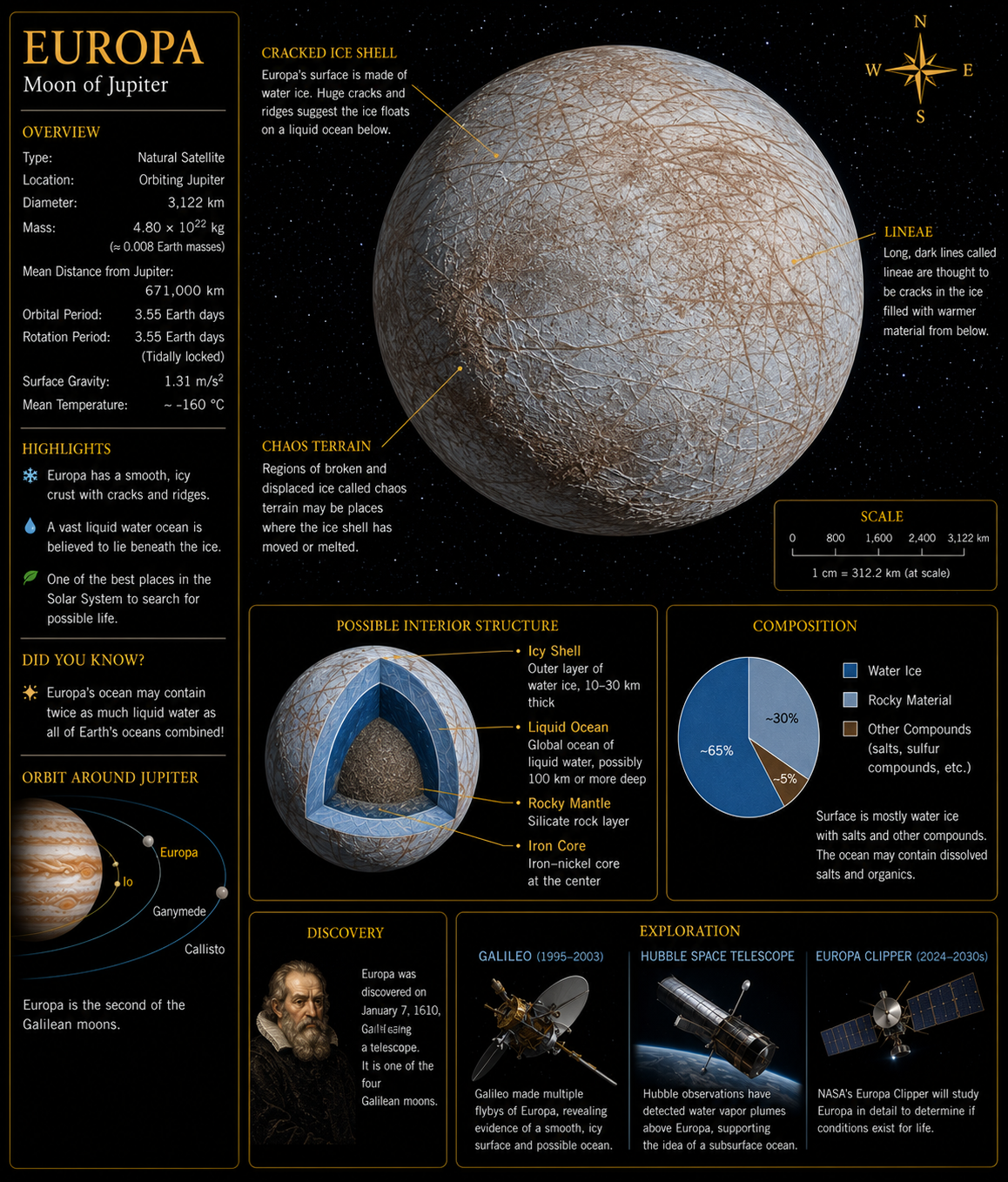
Europa detailed map
Moon

Europa

Jupiter’s icy ocean moon

Europa has a cracked icy surface and may contain a deep global ocean beneath its ice shell.

Why this world matters

Europa is one of the most important places to study possible life beyond Earth.

Interesting facts

  • Europa’s surface has long dark lines called lineae.
  • Its surface is smooth compared with many other moons.
  • A hidden ocean may contain more water than Earth’s oceans.
  • Future missions aim to study whether Europa could support life.

Try this

Design a probe that could study Europa without contaminating its ocean.

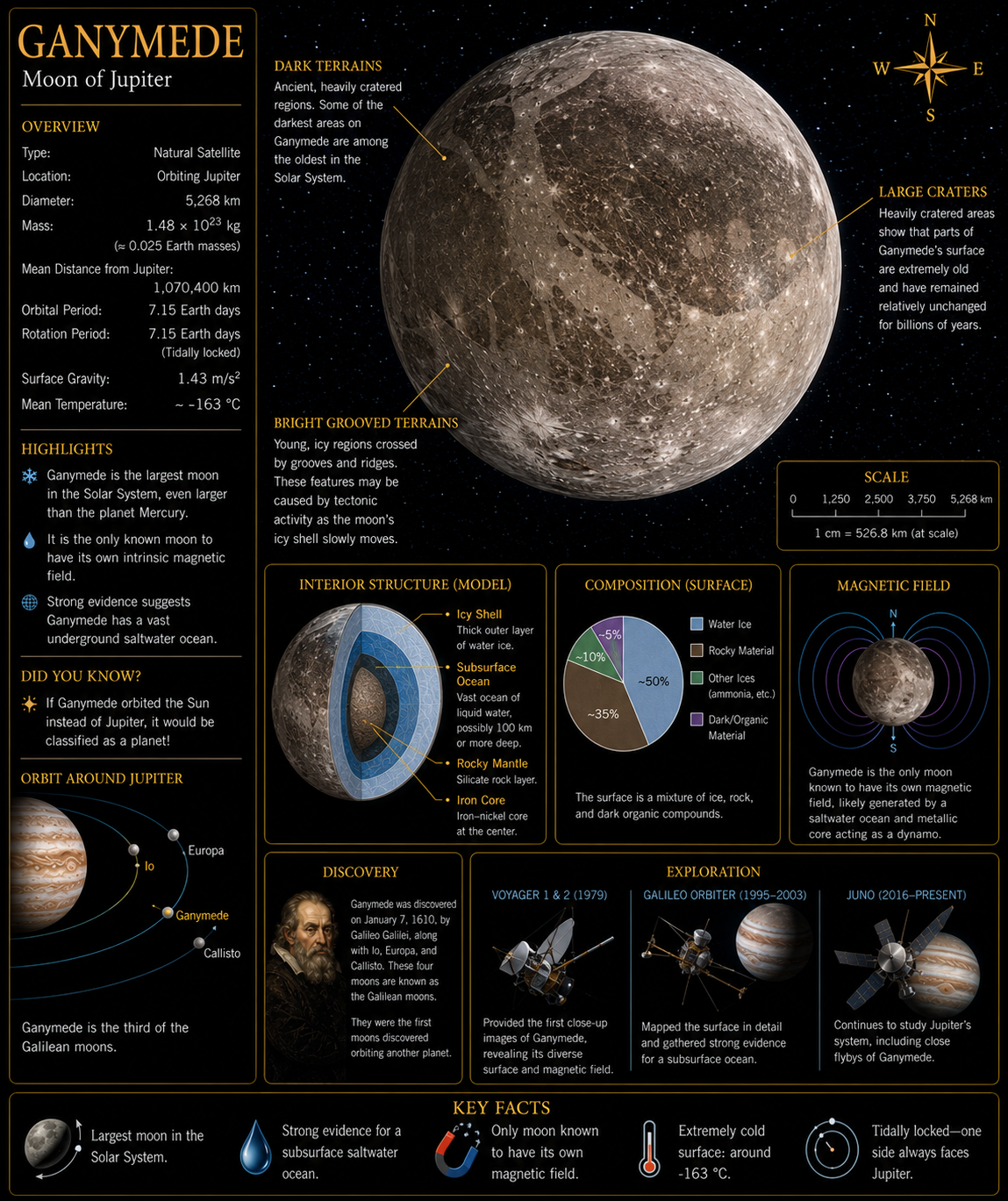
Ganymede detailed map
Moon

Ganymede

The largest moon in the Solar System

Ganymede is the largest moon in the Solar System and is bigger than Mercury.

Why this world matters

Ganymede is a moon that behaves like a complex world, with an icy surface, possible ocean and its own magnetic field.

Interesting facts

  • Ganymede is larger than Mercury.
  • It is the only moon known to have its own magnetic field.
  • Its surface has dark ancient regions and bright grooved terrain.
  • It is one of Jupiter’s four Galilean moons.

Try this

Compare Ganymede and Mercury. Why is one called a moon while the other is called a planet?

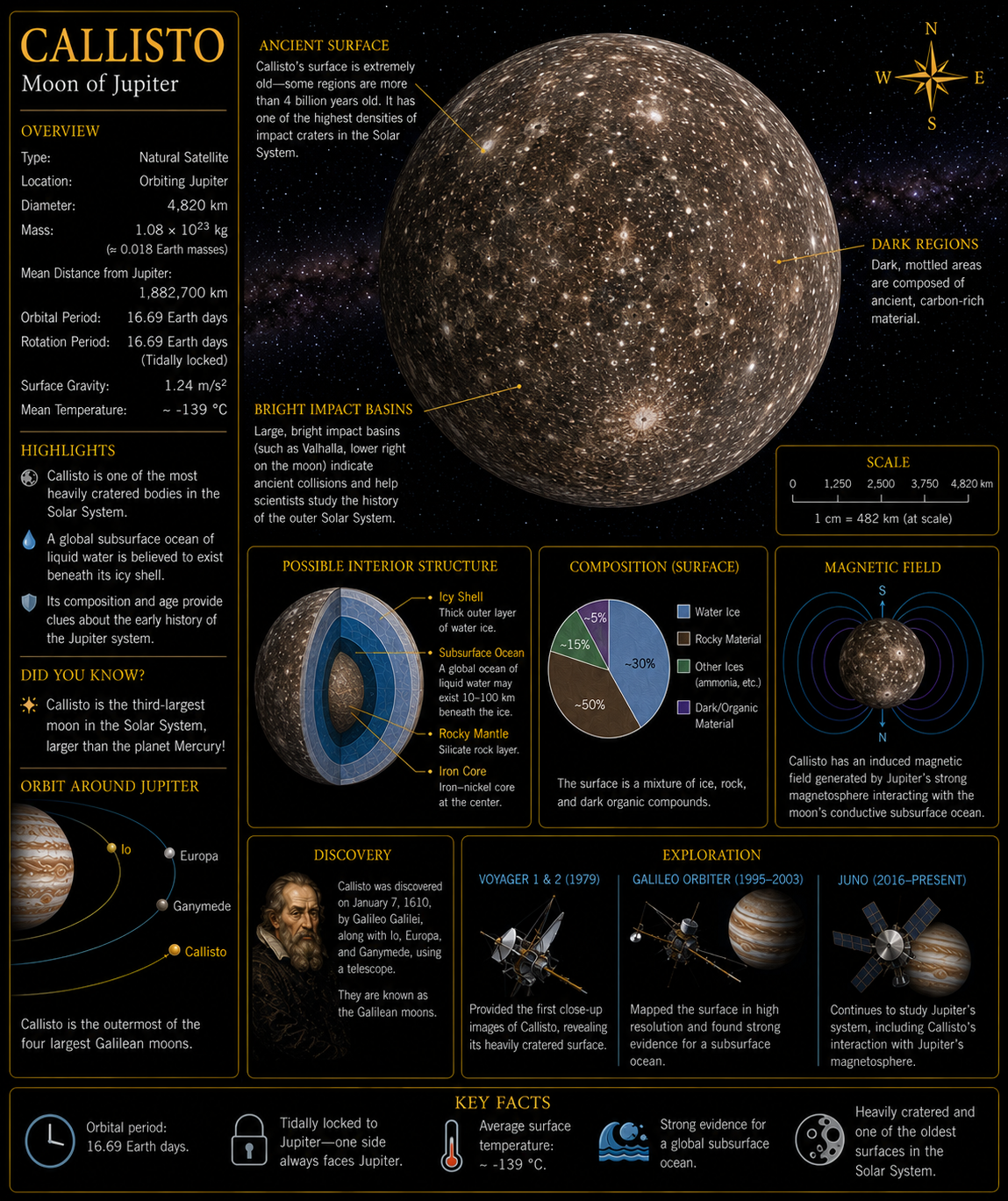
Callisto detailed map
Moon

Callisto

An ancient cratered moon

Callisto is an old, heavily cratered moon of Jupiter with one of the most ancient surfaces in the Solar System.

Why this world matters

Callisto is like a preserved record of early Solar System impacts.

Interesting facts

  • Callisto is covered with impact craters.
  • It is the outermost of Jupiter’s four Galilean moons.
  • Its surface has changed less than Io or Europa.
  • Some evidence suggests it may have a subsurface ocean.

Try this

Count visible craters in one area of Callisto and compare it with Europa.

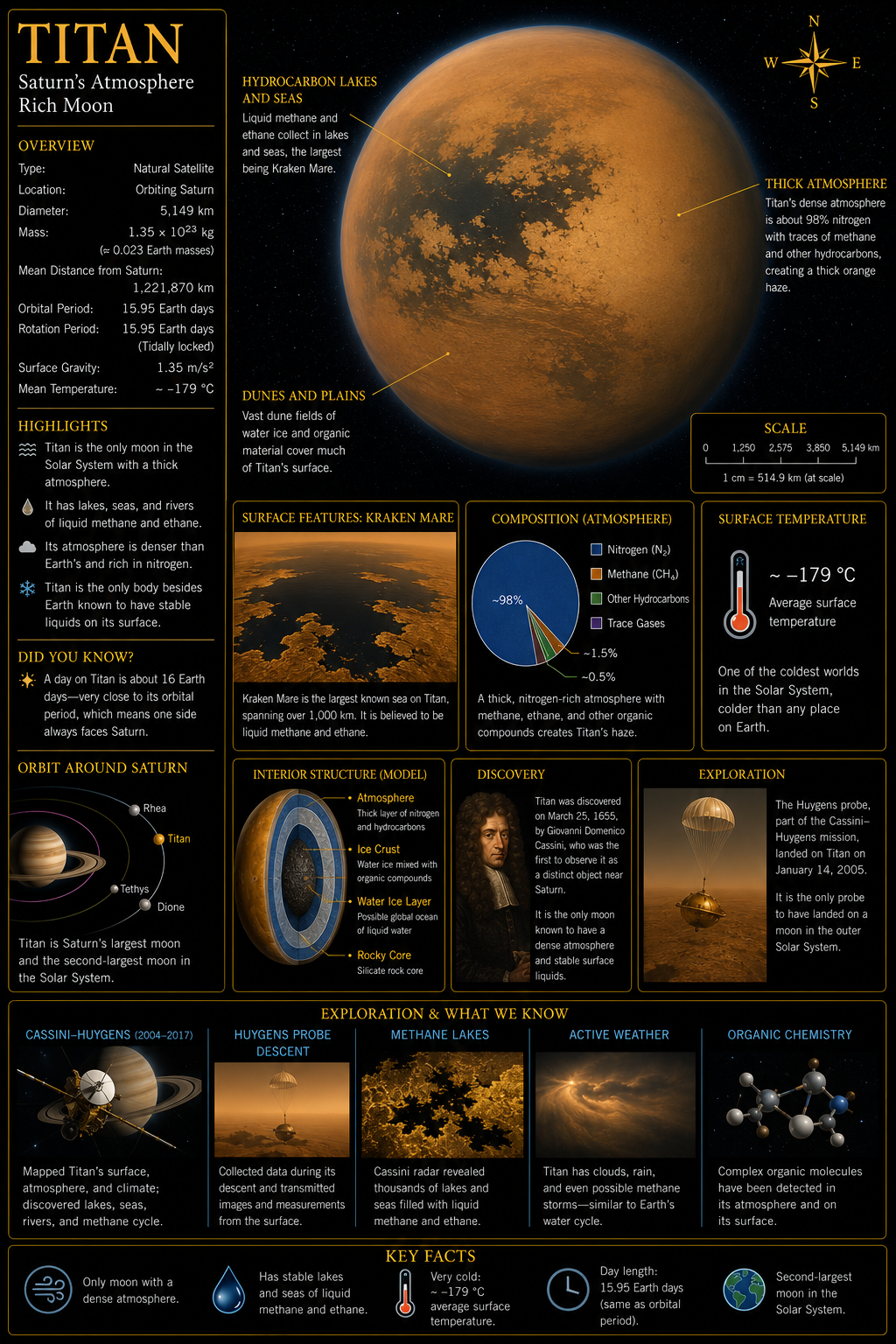
Titan detailed map
Moon

Titan

Saturn’s atmosphere rich moon

Titan is Saturn’s largest moon and has a thick nitrogen rich atmosphere, methane lakes, rivers and seas.

Why this world matters

Titan has weather, clouds and surface liquids, but the liquid is methane and ethane instead of water.

Interesting facts

  • Titan is larger than Mercury.
  • It has lakes and seas of liquid methane and ethane.
  • The Huygens probe landed on Titan in 2005.
  • Titan has a thick orange haze that hides much of its surface.

Try this

Compare Earth’s water cycle with Titan’s methane cycle. What is similar and what is different?

Space Atlas Activities

Use these activities to turn the images into real STEM learning. They work for home education, classroom learning, revision or family STEM time.

Compare two worlds

Choose Earth and Venus. Explain why one is habitable and one is extremely hostile. Use the comparison tool below.

Find impact history

Look at Mercury, the Moon and Callisto. Which surface looks oldest and most cratered?

Design a spacecraft

Pick Europa, Titan or Mars. Choose the instruments your spacecraft would need. Then try the Mission Builder.

Sort the Solar System

Group the cards into star, rocky planets, gas giants, ice giants, dwarf planets and moons.

Spot active worlds

Find worlds still changing today. Try the Sun, Io, Earth, Titan and Neptune.

Scale challenge

Use the Scale Calculator below. If Earth were a football, how far away would the Moon be?

Interactive tools

Pick any two worlds and compare their key stats side by side.

If Earth were the size of a chosen object, how big and far away would everything else be?

Choose a reference size and press Calculate Scale.

Answer five questions. We will tell you which world in the Solar System best matches your answers.

Tick off the worlds you have explored in this atlas. Progress saves in your browser.

0 / 20 worlds explored
The Sun
Mercury
Venus
Earth
The Moon
Mars
Jupiter
Saturn
Uranus
Neptune
Pluto
Ceres
Eris
Haumea
Makemake
Io
Europa
Ganymede
Callisto
Titan
Random space fact
did you knowLoading...